
Perspective, vertical perception, and why seeing a building differs from photographing it.
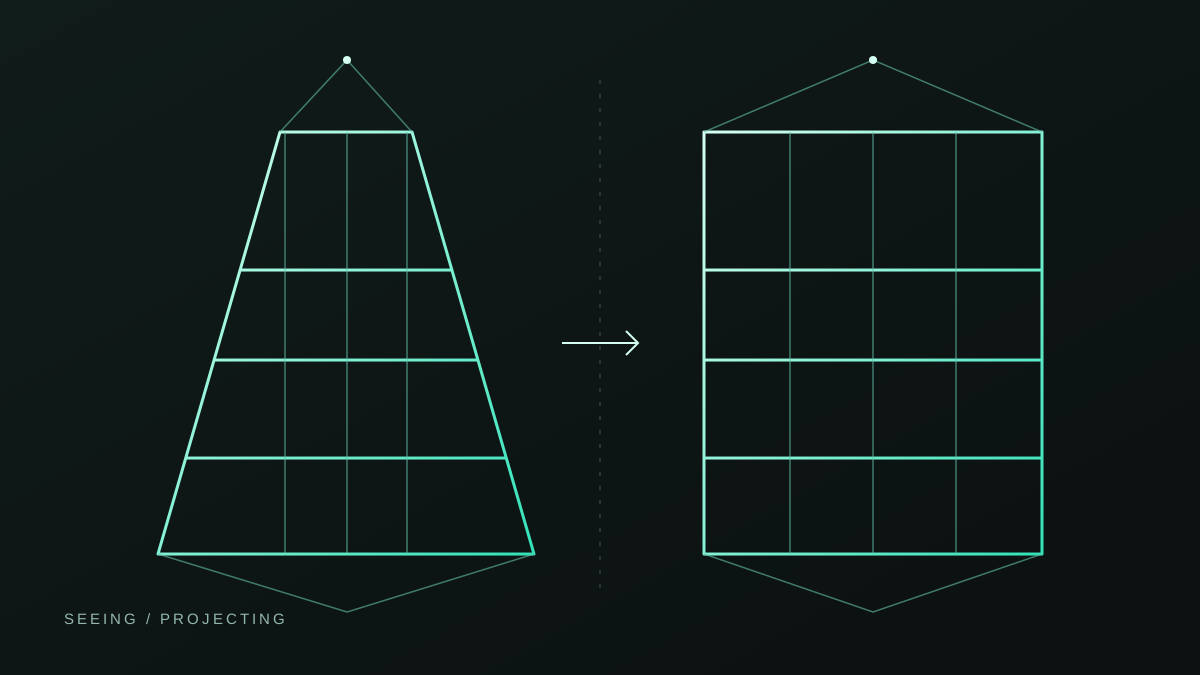
Imagine standing beneath a tall building. You look up. The façade feels tall, ordered, and firmly upright.
Then you raise your phone, tilt it back, and take a photograph. On the screen, the building narrows toward the top. Its sides seem to fall inward.
The tempting explanation is that our eyes automatically correct perspective while a camera does not.
That intuition points toward a real problem, but it compresses several different processes into one. Research supports a more careful distinction: perceiving an upright structure is not the same as receiving an image with parallel vertical lines. And looking at a photograph is not the same as returning to the place where it was taken. [1,2,7]
The interesting question is not whether the brain has a hidden perspective slider. It is why a geometrically correct photograph can differ from the building we feel we saw.
1. Upright in space does not mean parallel on the page
Consider two different questions. Are a building’s columns upright and parallel in three-dimensional space? And are their outlines parallel in a photograph?
The first concerns the structure. The second concerns its projection.
In an ideal pinhole camera, with the principal-point offset omitted and matching image-plane units, projection is:
Here, locate a point relative to the camera, and is focal length. Image position depends on depth as well as lateral position. [8]
It follows that pitching the camera upward gives the world’s vertical direction a finite vanishing point. Parallel vertical edges converge toward it. With a level camera and vertical image plane, that vanishing point is at infinity: the projected verticals remain parallel.
Convergence is therefore not necessarily a lens defect. Barrel distortion bends straight lines; perspective convergence can occur in a perfectly distortion-free camera. At a fixed position and orientation, changing focal length alone does not turn converging edges into parallel ones. [8]
The photograph has not discovered that the building is crooked. It has recorded one projection of it.
2. Perception asks about the object, not just its outline
Imagine a rectangular door rotating. Its outline on a fixed image plane changes, but its physical shape and its projected shape remain different things.
Shape constancy concerns how perceived shape can remain relatively stable across changes in observation. It does not require the underlying projections to remain unchanged. [2]
In two experiments reported in 2011, Yunfeng Li and Zygmunt Pizlo examined depth information and structural constraints in three-dimensional shape perception. Their tasks varied cues including edges and binocular disparity, and tested the contribution of symmetry and planar faces. For their particular stimuli, judgments could fall toward chance without the relevant structural constraints, even when binocular information was available. [2]
That does not establish symmetry as a universal rule. It shows that perceived structure can depend on more than a literal reading of projected outlines.
Applied to architecture, a reasonable inference is that converging contours can be interpreted as upright members extending into depth, rather than as members physically falling inward. This is an interpretation of spatial relationships—not evidence that the brain has produced a pixel-perfect corrected photograph.
3. Our sense of “up” also involves the body
Researchers often measure the subjective visual vertical , or SVV, by asking people to rotate a line until it appears aligned with gravity. The answer is not always physically vertical. Visual surroundings, vestibular information, and bodily cues all contribute. [3,4]
In 2024, Kanon Fujimoto and Hiroshi Ashida reported three experiments with 30 participants each. Through a head-mounted display, participants viewed scenes with different aspect ratios and depth information, then adjusted a line to look upright. Changing scene structure changed the pattern of verticality errors. [3]
Our internal plumb line is not independent of the room around it.
There is an important boundary here: these experiments investigated roll , or sideways tilt. Looking upward to photograph a tower involves pitch and projective convergence. Both concern spatial orientation, but SVV experiments alone do not demonstrate automatic correction of architectural keystoning. [3]
4. Bayesian models describe inference, not image stretching
When visual and bodily information disagree, which should carry more weight?
A simplified Bayesian account combines sensory evidence with prior information. Assuming a common cause and conditional independence of cues:
Here, is an orientation, is visual evidence, is bodily evidence, and is the prior. More reliable information generally receives greater weight. [4]
But perception is not necessarily forced averaging. In a 2018 study, de Winkel and colleagues independently manipulated visual and physical tilt and asked 36 participants to indicate the perceived upright with a pointer. A causal-inference model outperformed forced fusion, most clearly when cue discrepancies reached ±60°. It allowed for evidence arising from different causes rather than always treating it as one consistent signal. [4]
An orientation prior is not equivalent to assuming every architectural edge must be vertical. Nor does a successful behavioral model establish that neurons literally implement the displayed equation.
The evidence supports conditional spatial inference, not a universal straightening filter.
5. One paper addresses architectural photographs directly
In 2005, Dhanraj Vishwanath, Ahna R. Girshick, and Martin S. Banks published Why pictures look right when viewed from the wrong place in Nature Neuroscience . Their experiments manipulated viewing position and information about a picture’s surface. They proposed that estimates of local picture-surface slant help compensate for some changes caused by oblique viewing. [1]
Figure 7 addresses architecture explicitly. Buildings appear to lean together in a conventional upward-looking photograph; changing the projection plane makes them appear more upright. Under the specified monocular pinhole-viewing conditions, reducing surface-orientation information makes the percepts more similar. [1]
The crucial point: we see both a depicted building and the surface carrying its image. The brain does not stop interpreting when we look at a photograph; the available evidence changes.
The formal experiments involved six observers. The architectural photographs were perceptual demonstrations, not a universal test across buildings and viewing conditions. [1]
6. Identical towers can appear to lean differently
In 2007, Frederick Kingdom, Ali Yoonessi, and Elena Gheorghiu reported the Leaning Tower illusion . Place two identical photographs of the Leaning Tower of Pisa side by side, and the right-hand tower can appear more tilted. [5]
The individual images have not been stretched differently.
The authors proposed that the visual system groups them into one scene. Parallel towers receding from a shared viewpoint would normally have converging projected axes. When corresponding axes instead remain parallel—as they do in the duplicated photographs—the configuration can suggest divergence in depth. [5]
The perceived lean therefore depends on more than an edge’s angle in one image.
In 2018, Giulia Parovel and Alan Costall produced related demonstrations using the upright St Mark’s bell tower. They varied camera distance and the tower’s peripheral position to explore the relationship between perspectival obliqueness and the illusion. This was a set of visual demonstrations, not a large participant experiment with statistical estimates; competing accounts, including orientation contrast, have also been discussed. [6]
The illusion is evidence that perspective is interpreted in context. It is not evidence that the brain invariably makes architectural edges parallel.
7. A photograph has another viewpoint: yours
The size of a displayed photograph and the observer’s distance from it determine how it projects into the eyes. A geometrically correct source image does not guarantee the same spatial impression under every viewing condition. [7]
In a 2012 Journal of Vision paper, Emily A. Cooper, Elise A. Piazza, and Martin S. Banks investigated this mismatch. One experiment, with five participants, held viewing distance fixed while changing the projection distance used to render two connected planes. Observers judged the angle between the planes. Under those conditions, they did not adequately compensate for the mismatch, and perceived depth changed. [7]
This was not a direct test of automatic vertical correction in tall buildings. Its relevance is narrower but important: reproducing a correct projection does not necessarily reproduce the original spatial experience.
A photograph is a presentation of a scene, viewed under a new set of conditions—not the scene itself.
8. What this means for Plumb
The useful engineering connection is not “copy the brain.” It is use more than the image alone when the capture process makes additional information available .
Plumb’s published documentation states that it retains capture-time camera and motion information, uses motion and gravity samples alongside camera intrinsics for correction, and creates a separate corrected version on the device. [10,11]
A general geometric model for reprojecting an image into a differently oriented virtual camera, without moving the optical center, is:
The matrices and describe the source and target camera intrinsics; changes their relative orientation. The points use homogeneous pixel coordinates. This is a general relationship, not a specification of an app’s complete implementation. [9]
A suitable level target orientation can render genuinely vertical lines parallel. This remains perspective, not an orthographic elevation. Under the ideal pure-rotation model, it does not require the entire scene to lie on one plane. [8,9]
Gravity alone does not determine heading around the vertical axis or identify a façade’s normal. Reprojection cannot reveal uncaptured content. Mapping a finite source image into a new frame also involves stretching, resampling, empty regions, and crop choices. [8,9]
The goal should not be to force every architectural edge upright: genuinely inclined columns and façades should retain their spatial character.
A more defensible ambition is to reduce the influence of capture orientation on how a building’s upright structure is communicated. That is a design objective—not an outcome these studies have already validated for Plumb.
9. Fidelity to a projection, or clarity about a structure?
These are two possible photographic aims: preserve the projection from a particular capture position and direction, or communicate a building’s spatial order clearly on a flat image.
Neither has to invalidate the other. A photographer may choose strong convergence to express height or tension, or parallel verticals to emphasize structure. This is a representational choice, not automatically a contest between truth and fabrication.
The research gives us reason to keep two statements separate: an optically correct image need not look natural under every viewing condition; perceiving an upright building does not mean that vision has eliminated all perspective. [1,7]
Whether a particular correction looks more natural, resembles an on-site experience more closely, or is preferred by architects requires direct testing. These are different questions, and none should be assumed to follow automatically from the studies above.
For Plumb, the guiding ambition can remain simple:
Not to make a building into something it is not, but to let capture orientation interfere less with how the building is seen.
References and technical sources
[1] Vishwanath, D., Girshick, A. R., & Banks, M. S. (2005). Why pictures look right when viewed from the wrong place. Nature Neuroscience, 8, 1401–1410. DOI: 10.1038/nn1553. Full text. See Figure 7 and “The anamorphic effect and architectural photography.”
[2] Li, Y., & Pizlo, Z. (2011). Depth cues versus the simplicity principle in 3D shape perception. Topics in Cognitive Science, 3(4), 667–685. DOI: 10.1111/j.1756-8765.2011.01155.x. PubMed abstract. The account here is limited to findings verifiable in the abstract.
[3] Fujimoto, K., & Ashida, H. (2024). Influence of scene aspect ratio and depth cues on verticality perception bias. Journal of Vision, 24(7), 12. DOI: 10.1167/jov.24.7.12. Full text.
[4] de Winkel, K. N., Katliar, M., Diers, D., & Bülthoff, H. H. (2018). Causal Inference in the Perception of Verticality. Scientific Reports, 8, 5483. DOI: 10.1038/s41598-018-23838-w. Full text.
[5] Kingdom, F. A. A., Yoonessi, A., & Gheorghiu, E. (2007). The Leaning Tower illusion: a new illusion of perspective. Perception, 36(3), 475–477. DOI: 10.1068/p5722a. PubMed. Authors’ demonstration.
[6] Parovel, G., & Costall, A. (2018). Increasing Perspectival Obliqueness Increases the Leaning Tower Illusion. i-Perception, 9(1). DOI: 10.1177/2041669518758778. Full text.
[7] Cooper, E. A., Piazza, E. A., & Banks, M. S. (2012). The perceptual basis of common photographic practice. Journal of Vision, 12(5), 8. DOI: 10.1167/12.5.8. Full text.
[8] OpenCV. Camera Calibration and 3D Reconstruction. Official documentation. Source for the pinhole model, intrinsic/extrinsic parameters, and lens-distortion distinction; geometric consequences in the article follow from this model.
[9] OpenCV. Basic concepts of the homography explained with code. Official documentation. See the pure-rotation camera example.
[10] Plumb. Frequently Asked Questions. Official documentation. Used for product-description claims, not independent perceptual validation.
[11] Plumb. Privacy Policy, updated September 19, 2026. Official documentation. Used to verify the description of motion/gravity samples, camera intrinsics, and on-device processing.