
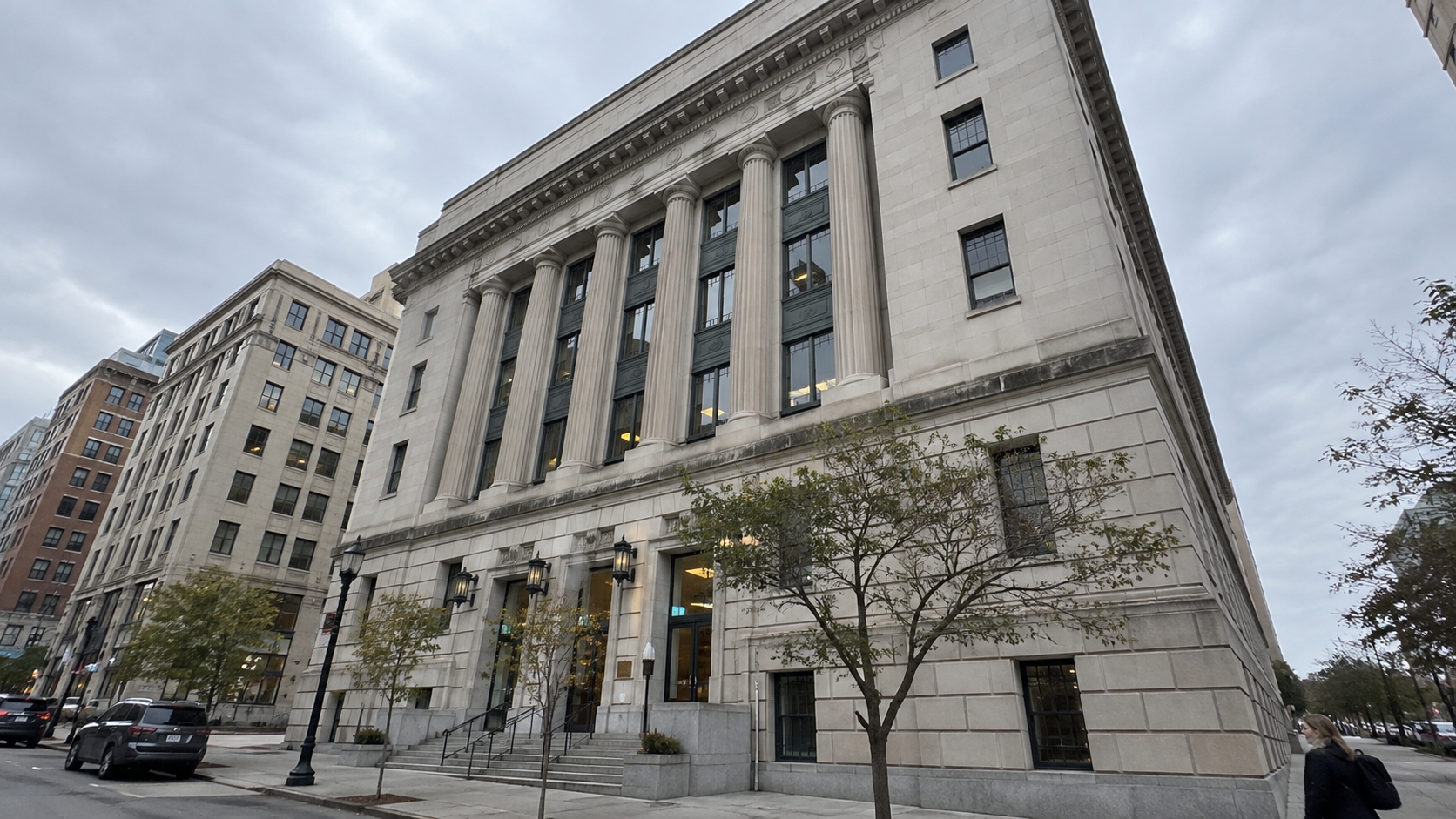
You are standing on a sidewalk in front of a building. The façade fills most of the frame, but the roof is missing. So you do the natural thing: you tilt your iPhone upward.
Now the whole building fits.
But something else has changed. The vertical edges of the building no longer look parallel. They lean inward as they rise, appearing to meet somewhere above the photograph.
Nothing is necessarily wrong with the lens, and the building has not suddenly started leaning. What you are seeing is a normal consequence of perspective.
Understanding why it happens—and why architectural photographers sometimes correct it—is useful even if you never use a perspective-correction tool.
Why do vertical lines converge when you point the camera upward?
A camera turns a three-dimensional scene into a two-dimensional image.
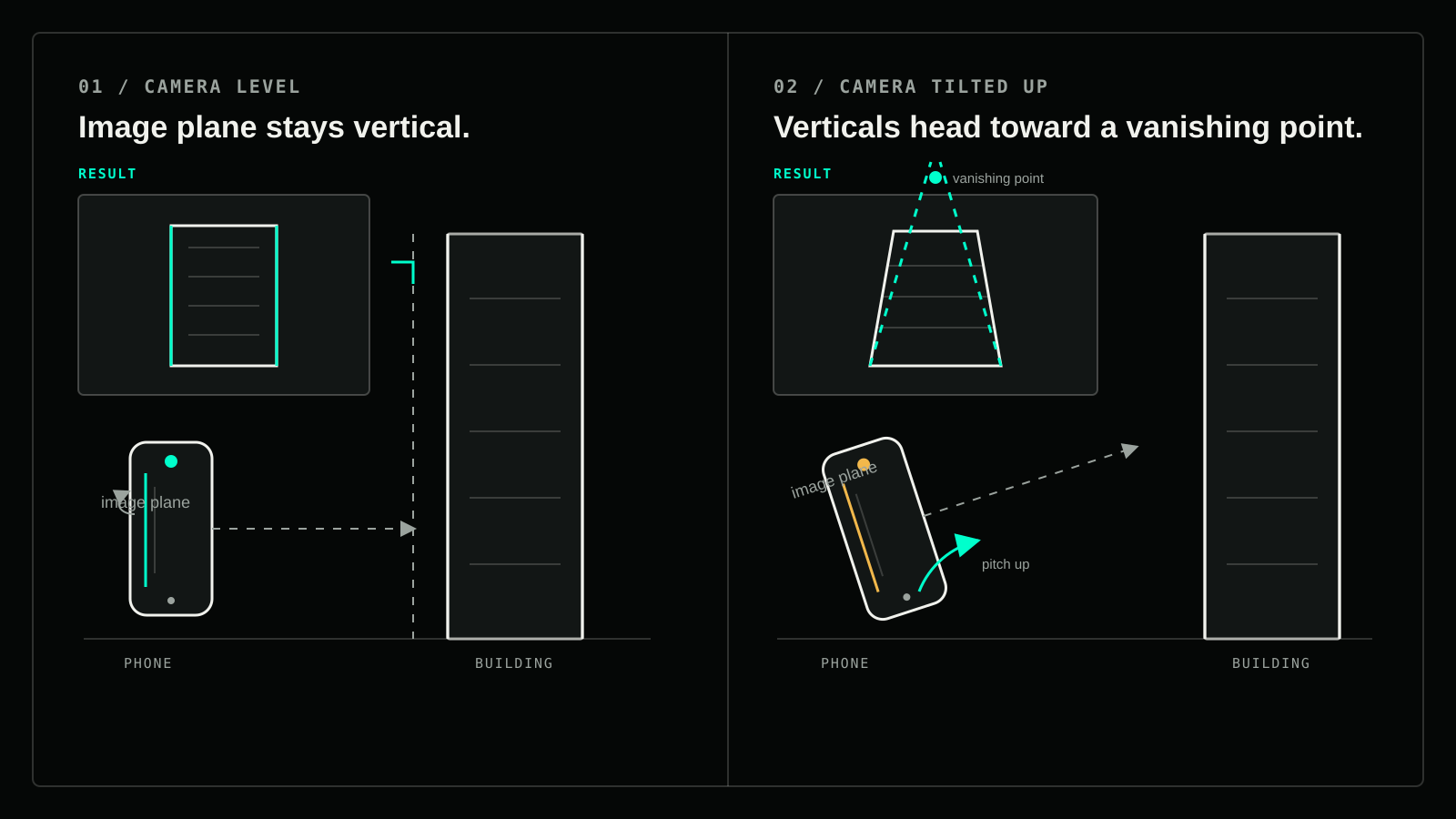
One simple way to think about this is to imagine the camera sensor as a flat image plane. When the phone is held upright and the image plane is aligned vertically, the vertical direction of a conventional building is also parallel to that plane. In the photograph, genuinely parallel vertical edges can therefore remain parallel.
Tilt the phone upward, however, and the relationship changes.
The image plane is now tilted relative to the building. In perspective projection, parallel lines that are no longer parallel to the image plane appear to head toward a vanishing point. For the building’s vertical edges, that vanishing point is somewhere above the frame.
The farther you tilt upward, the more obvious the convergence usually becomes.
This is perspective, not automatically a defect.
It is also worth separating perspective from lens distortion. Barrel or pincushion distortion can bend lines because of optical characteristics. Converging verticals are different: even an ideal pinhole camera produces them when the camera is tilted.
A wide-angle lens does not, by itself, create this perspective either. Perspective is determined primarily by viewpoint and camera orientation. Wide lenses often make the effect more noticeable in practice because they let us stand close to a building, include more of it, and tilt the camera aggressively.
Why are verticals often corrected in architectural photography?
If convergence is normal perspective, why remove it?
Because photography is not only about reproducing what a camera projects. It is also about deciding what information an image should communicate.
In architectural documentation, façade photography, interiors and many design publications, photographers often want the image to describe the building’s geometry clearly. Walls, columns, mullions, door frames and structural grids that are vertical in reality are important visual references.
When those references strongly converge, attention can shift from the architecture itself to the viewpoint of the camera. A corrected image can make proportions, alignments and relationships easier to read.
This is especially useful when photographs are being used to discuss a façade, compare design decisions, record a space or communicate an architect’s work.
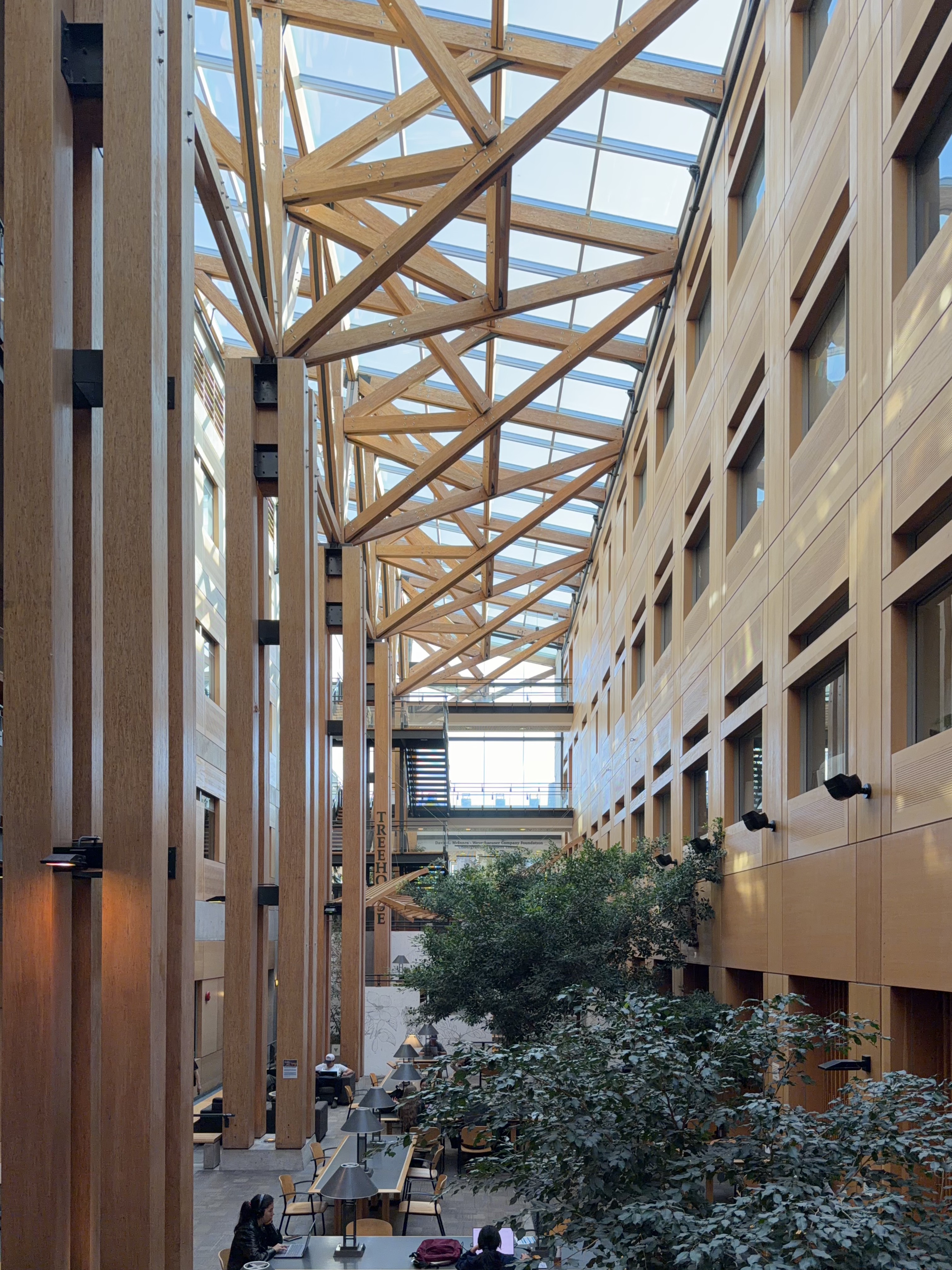
There is also a perceptual reason. When we stand in front of a building, our visual experience is not identical to a single frozen wide-angle photograph. Our eyes move, our head moves, and our brain continuously interprets orientation and gravity. A strongly converging still image can therefore feel more dramatic than our memory of being there.
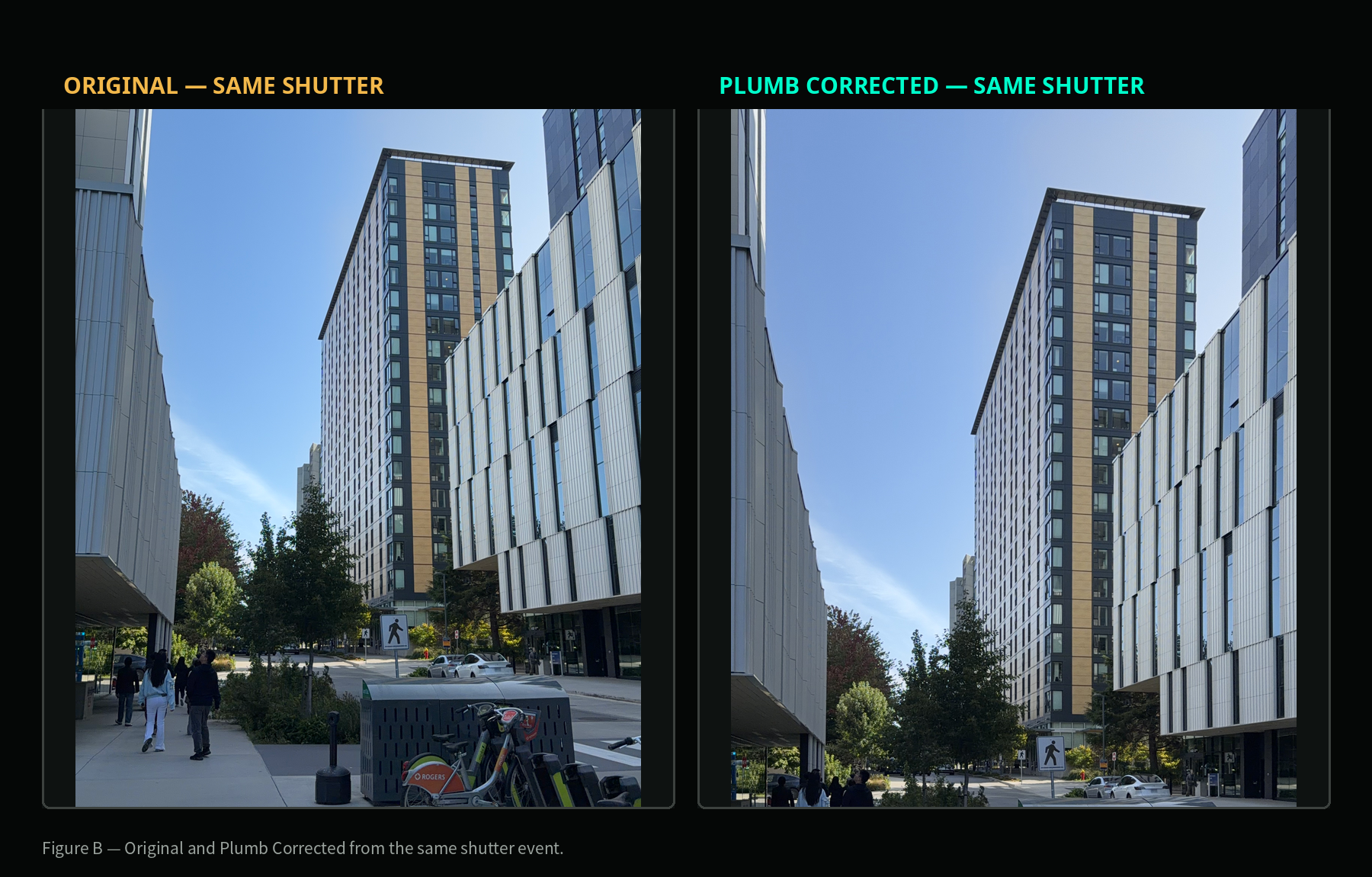
Making real verticals appear closer to parallel is one photographic convention for producing a calmer, more descriptive representation.
Correction is a choice, not a rule
None of this means that every architectural photograph should have parallel verticals.
Sometimes convergence is the photograph.
Pointing a camera upward can emphasize height, monumentality, density or even discomfort. A narrow street framed by towers may feel more powerful when the buildings accelerate toward the sky. A close view from the base of a column can deliberately exaggerate its vertical force. Street photography may benefit from preserving the viewer’s actual low viewpoint rather than neutralizing it.
In those cases, correcting the verticals may weaken the image.
The relevant question is not:
“Are the verticals perfectly straight?”
It is:
“Does the perspective support what this photograph is trying to say?”
Correct only lines that are actually vertical
There is another important boundary.
Not every diagonal line in architecture is supposed to be vertical.
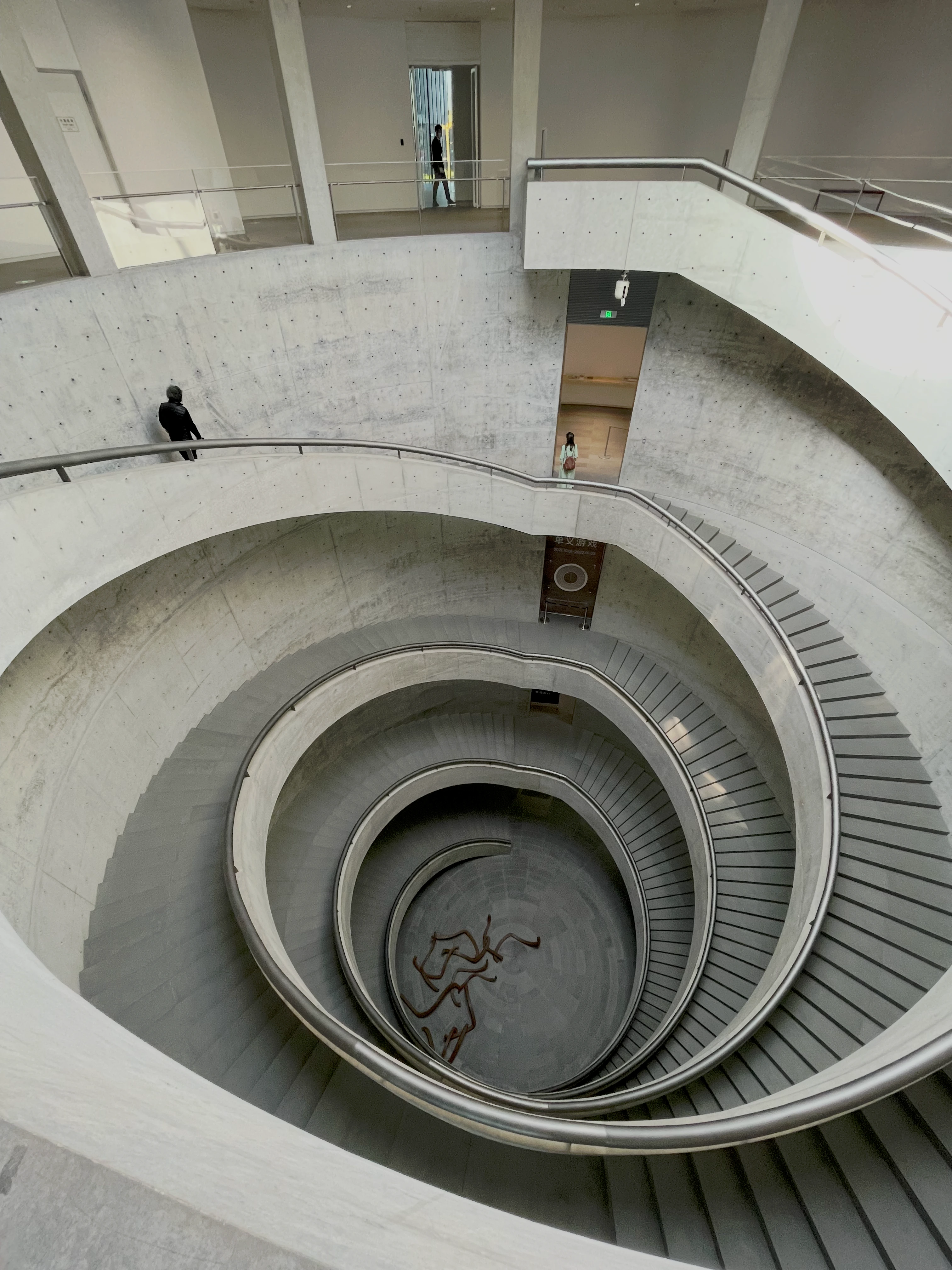
A leaning column, sloped wall, folded façade, bracing member or intentionally inclined structural element should remain inclined. Forcing such elements upright would not correct perspective; it would misrepresent the design.
The same caution applies when an image contains several planes at different orientations. A software tool may detect strong edges, but geometry alone cannot always tell you the architect’s intent.
Perspective correction therefore requires judgment.
The goal is not to make every line obey a grid. The goal, when correction is desired, is to represent directions that are genuinely vertical in the scene as vertical—or approximately vertical—in the image.
Vertical correction does not remove all perspective
Straightening verticals does not turn a photograph into an orthographic elevation.
Depth remains.
If you photograph a building from a corner, horizontal edges receding away from you will still head toward left and right vanishing points. Objects farther from the camera will still appear smaller. Near and far façades will still have different apparent scales.
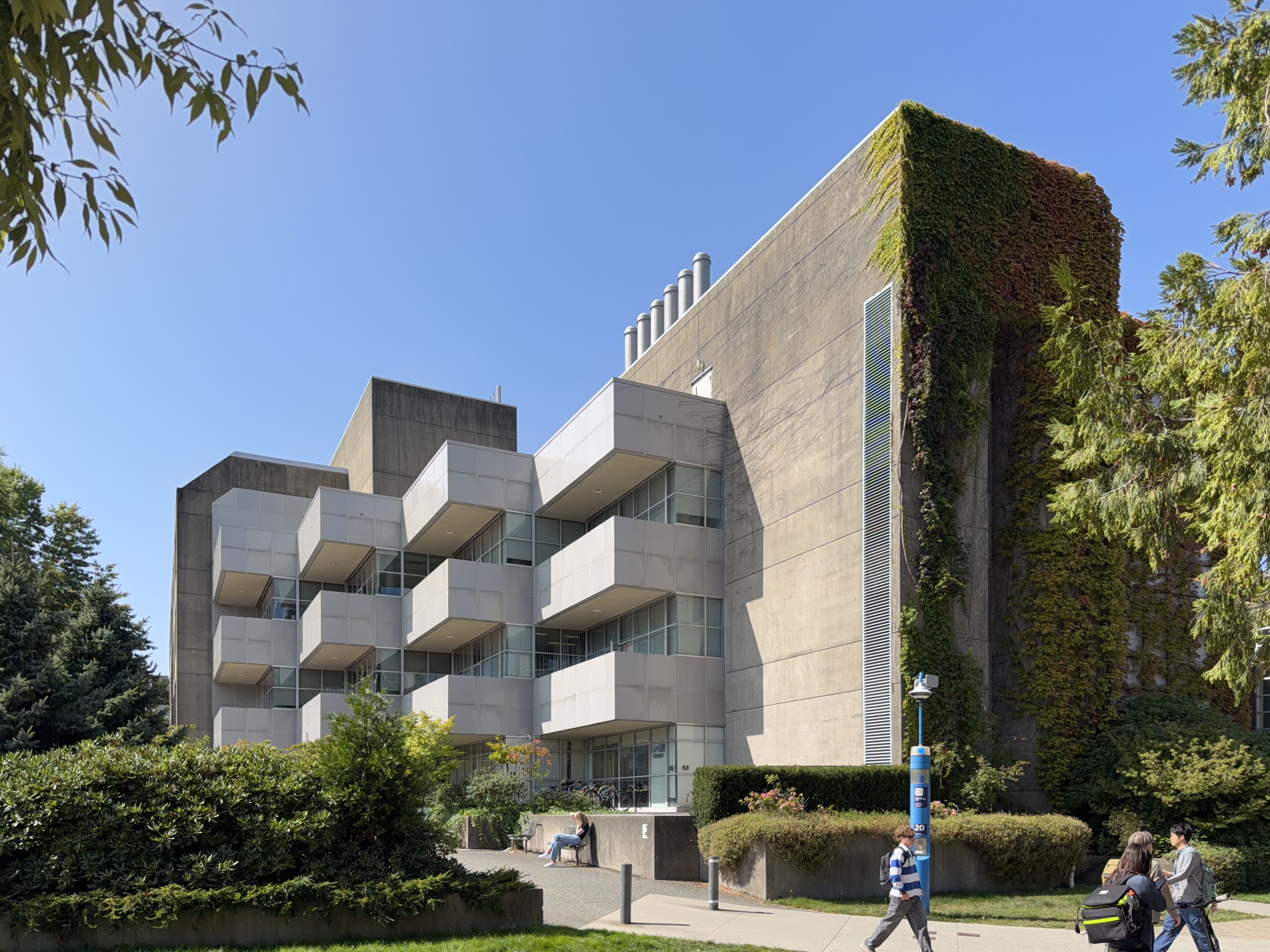
Vertical correction changes one part of the perspective relationship. It does not remove perspective altogether.
For the same reason, a corrected photograph should not be treated as a survey drawing or a dimensionally reliable orthographic record. It remains an image produced from a particular camera position, through a particular lens and projection, then possibly transformed afterward.
If dimensions matter, they need to come from appropriate measurement or surveying methods—not from the visual appearance of a corrected photograph alone.
Three ways to control converging verticals
There is no single correct method. Perspective can be managed before, during or after capture.
1. Improve the camera position
The simplest solution is often physical.
Move farther away if space allows. Find a higher viewpoint. Keep the phone more nearly vertical and include the top of the building with a wider field of view.
This reduces the amount of upward pitch and therefore reduces vertical convergence at capture.
It is often the cleanest approach, but cities rarely provide ideal camera positions. Streets may be narrow, trees may block the view, traffic may prevent stepping back, and the opposite side of the street may still be too close. A higher viewpoint may not exist at all.
2. Use a shift lens
Specialized perspective-control lenses provide another solution.
For architectural work, the important movement is shift. Instead of pointing the entire camera upward, the photographer can keep the camera body level and shift the lens upward relative to the sensor. The framing moves upward while the image plane remains aligned more closely with the building’s vertical direction.
This helps keep vertical lines parallel at capture.
The word “tilt-shift” can be slightly misleading here because the two movements do different jobs.
Shift changes the position of the lens’s optical axis relative to the image area and is the movement commonly used to control architectural perspective.
Tilt changes the angle of the lens relative to the image plane and is mainly used to change the orientation of the plane of focus.
Many specialist lenses provide both, which is why the terms are often spoken together.
Shift lenses can produce excellent results, but they add specialized equipment, cost, size and setup time—and they are not a normal option for iPhone photography.
3. Correct perspective in software
The third approach is to transform the image after capture.
Software can remap the photograph so that selected vertical directions become parallel or closer to parallel. This is flexible and works with cameras that have no optical shift mechanism.
But the transformation has consequences.
When a trapezoidal image region is remapped toward a rectangle, the resulting image boundary no longer matches the original rectangular frame. Empty areas can appear near the edges, which usually means the image must be cropped, scaled or otherwise reframed.
Parts of the image may also be stretched more than others. Because the output has to be resampled onto a new pixel grid, the correction is not literally free of image-quality cost. The stronger the transformation, the more carefully cropping and detail should be evaluated.
Most importantly, software cannot recover scene content that the camera never captured. If the roof was outside the original frame, perspective correction cannot reconstruct a real photographic record of that missing roof.
Correction works with the information that was captured. It does not travel back in time and change the camera position.
How much correction is enough?
The mathematically strongest correction is not always the visually best one.
A photograph can look unnatural if perspective is pushed beyond what the scene and viewpoint can support. Near the edges, strong correction may stretch people, furniture or architectural details. A perfectly parallel result may also feel overly rigid when the original view was clearly made from close range.
For that reason, architectural perspective correction is often best treated as a continuum rather than an on/off rule.
- You can fully parallelize the verticals.
- You can reduce the convergence without eliminating it.
- Or you can leave the original perspective untouched.
The appropriate choice depends on the purpose of the photograph.
If the image is primarily a record of a façade or interior, more correction may improve legibility. If the image is primarily about the experience of looking upward, less correction—or none at all—may be more truthful to the photographic idea.
A useful question before correcting
Before adjusting an architectural photograph, ask:
“Am I trying to describe the building, or describe the experience of looking at the building from here?”
Many photographs do both, but the balance changes the answer.
Vertical correction is one of the tools available for making that decision visible. It is not a declaration that converging lines are wrong.
Where Plumb fits
Plumb brings post-capture, on-device perspective correction and preservation of the original capture into the same iPhone photography workflow.
That supports one particular photographic choice: creating a corrected interpretation while keeping the photograph that came directly from the capture.
It does not mean every building should be photographed with parallel verticals. Sometimes correction is useful. Sometimes convergence is exactly the point.
The important part is knowing why you are choosing either one.
Sources and further reading
Architectural photography with iPhone
Explore practical guides to photographing tall buildings, correcting perspective and leaving room for the final crop.